

Faith
So, you want to get on the liturgical calendar? It's not impossible, but not easy.
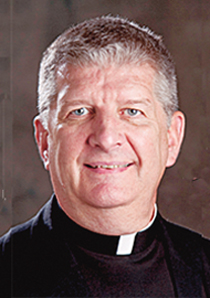
Father Robert M.
O'Grady
O'Grady
So, you want to get on the liturgical calendar? It's not impossible, but not easy. Basically, you must be a saint, and one who is recognized by the Church, or canonized.
When you look at the General Calendar in the Roman Missal, the most obvious thing is that the saints predominate. There are no blesseds on the General Roman Calendar. You will notice that there are some dates, very important ones, that are not saints' days.
First, there are all the dates assigned to Christ, including the Paschal Triduum, his Nativity, his Resurrection, his Ascension and his Transfiguration; then those associated with him, such as the Presentation in the Temple and the Exaltation of the Holy Cross, for example. And there is also the Dedication of the Lateran Basilica. Yes, the anniversary of the dedication of any cathedral or parish church is a feast of the Lord!
Next, and to no one's surprise, are the dates assigned to the Most Holy Mother of God, the Theotokos. There is her principal feast on Jan. 1, her Immaculate Conception and her Assumption, her birthday, her name day, her presentation in the Temple, her seven sorrows, and the devotional ones: Most Holy Rosary, Fatima, Lourdes, et al.
Then all the other saints.
There is a process of becoming a saint. It's simply living the Christian life, completely and fully, loving God and neighbor as God has loved you, doing your best to use your gifts and talents to help and serve others, and worshipping God and receiving the sacraments. That makes you a saint. Getting on a calendar is another, usually very long, process.
For some, the process is not long at all. On Oct. 3, we celebrated the 800th anniversary of the death of Giovanni di Pietro di Bernardone, who was canonized just 21 months later on July 16, 1228, by Pope Gregory IX. You know Giovanni better as Francis of Assisi.
While there are some exceptions, more recent ones are Pope St. John Paul II and Teresa of Kolkata, the process to be canonized is long and involved. It takes years. There is a carefully designed, multi-step process.
What follows is a very brief review of the process itself. Keep in mind there are all kinds of details along the way that must be followed. An extensive biography of the candidate must be compiled. Documentation and testimony about the individual's life and practice of the faith are reported. This usually begins in the diocese where the person lived, or carried on the greater part of their ministry or, rarely, in the place of birth.
Everything is submitted to the judgment of the Holy Father, who entrusts all the "groundwork" to an office in the Roman Curia called the Dicastery for the Saints. The men and women working there review the documentation and make recommendations in each case to the pope about the advisability of proceeding with the case.
Different kinds of experts serve as members or advisors of the Dicastery for the Saints. Some of these include canon lawyers, historians and medical personnel, especially when investigating cures submitted for investigation as miracles.
Sometimes a case is returned to the diocese looking for more information. Sometimes it is returned with the notification that the case cannot proceed at this time. A recent example was earlier this year when the case of Jesuit Father Walter Ciszek was returned to the promoters.
Once a case gets the go-ahead, the proposed person may be called "Servant of God." As the case proceeds and the pope gives the nod, the person may be designated "Venerable." If, at that stage, the person has died as a martyr, then Venerable applies, but the next step to beatification follows immediately on the pope's approval, and the person is designated "Blessed" following the appeal decree. If not a martyr, then a verified or certified miracle must be attributed to the candidate's intercession; only then can this person, following the papal decree, be declared and honored as a blessed.
In our country, we witnessed the beatification of John Peter Fulton Sheen in St. Louis, with Pope Leo XIV being represented by Cardinal Luis Tagle. His cause required a miracle. On the other hand, in Savannah, Georgia, on Oct. 31, Cardinal Frank Leo will beatify Franciscan Friars Pedro de Corpa and his companions, called the Martyrs of Georgia.
Once the pope acts on the recommendations, he will issue a decree for the beatification and assign a date. Since most beatifications take place outside Rome, he will designate someone, usually a cardinal, to represent him at the ceremony.
The last step is the canonization, which requires two additional miracles and the papal approval of the reports. The Holy See sets the date for the canonization, and these are generally celebrated in Rome. The pope is the celebrant and decrees the saint or saints to be listed in the martyrology. Most, but not all, theologians tend to agree that canonization is an infallible act of the pope.
That's a long answer about getting to be a saint. Next, comes getting a date on a calendar.
Help us expand our reach! Please share this article on social media

Recent articles in the Faith & Family section
-

Singing to the LordFather Robert M. O'Grady
-

SuperstitionArchbishop Richard G. Henning
-

Lessons Learned from the Missions -- Part IMaureen Crowley Heil
-

Settling accountsScott Hahn
-

Talents and crossesFather Joshua J. Whitfield


