

Faith
With all the various calendars and ranks, and titles, and patronages, we might overlook that the point of all this is to show us the holiness of the lives of our sisters and brothers ... .
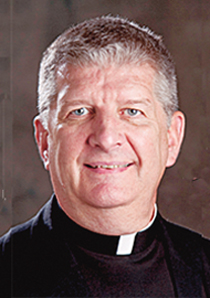
Father Robert M.
O'Grady
O'Grady
Saints can be on one or several calendars.
Once on the General Roman Calendar with an assigned rank -- solemnity, feast, obligatory memorial, or optional memorial -- you can get a different rank on another calendar. You might say you can get a bump, and any bump will be up. Your rank on that calendar cannot be bumped down, though its observance might be surpassed by a more important feast. This can happen with the Annunciation of the Lord (March 25) and St. Joseph (March 19). If either occurs during Holy Week, its observance is moved to the Monday after the Second Sunday of Easter.
For the bump, there are some examples.
The feast of the Exaltation of the Holy Cross on Sept. 14 is a feast on the General Calendar. It replaces the 24th Sunday in Ordinary Time when Sept. 14 is a Sunday. However, at the Metropolitan Cathedral of the Holy Cross in Boston, it is always celebrated as a solemnity because it is the titular or title or name of the cathedral and so its feast. The same would apply to any church anywhere named Holy Cross.
Recently, St. John Henry Newman was added as an optional memorial on the General Calendar on Oct. 9, and so his memorial may be observed throughout the Church on that day. However, across Britain and Wales, he's bumped up to a feast on their National Calendar, and so his feast takes priority. If a parish has his title or a church is dedicated in his honor, then it's a solemnity.
St. Dominic has an obligatory memorial on the General Calendar. On the calendar of the Order of Preachers, the Dominicans, he's bumped up to a solemnity on Aug. 8. And because of the close relationship with the Franciscans, Aug. 8 is also a feast for St. Dominic.
If a diocese has its own calendar, which can happen once it is proposed and approved by the Holy See, then other saints could be celebrated according to some rules for calendars. Usually, a diocesan calendar would incorporate the General Roman Calendar, a national calendar as we have in the United States, and celebrations of special note to the diocese.
The titles of the diocese's parishes, if not on the General or National Calendar, would be incorporated. Likewise, the rank of certain celebrations on either of those calendars might be changed in a diocesan calendar. So, our diocesan calendar would have saints who are on neither the General nor our National calendars but could be on our diocesan calendar. Some examples of these saints are Brigid of Kildare (Feb. 1), Eulalia (Feb. 12), Joan of Arc (May 30), Linus (Sept. 23), Columbkille (June 9), Irene (Jan. 22), and Bernadette Soubirous (April 16). Each, as cited, has an assigned feast day but not on either the General or National Calendar.
The various religious orders in the Church also have calendars. These incorporate first the General Calendar and then add the saints and blesseds who were members of the respective order. The following are some of those with their own calendars: Augustinians, Benedictines, Carmelites, Dominicans, Franciscans, Jesuits, Marists, and Redemptorists. If you are in a parish entrusted to one of these orders, went to one of their schools, or visited their convents, you might be there for one of their particular celebrations.
The other Catholic Churches also have calendars. Our brothers and sisters in the great Eastern Catholic Churches -- Armenian, Chaldean, Coptic, Melkite, Maronite, Syriac -- would also have calendars. Some of their observances of saints' days vary from the Latin calendar. And they have saints of their own who are not on any other calendars.
There are so many saints and blesseds who have been so declared that there really is not enough room for all of them on any one calendar or on several taken together.
With all the various calendars and ranks, and titles, and patronages, we might overlook that the point of all this is to show us the holiness of the lives of our sisters and brothers over the centuries, around the globe, and in persecution and peace, are models for us to imitate as they imitated Christ.
The liturgy always provides a point of reference, and our prayers summarize our faith. The first of two prefaces for the saints in the Roman Missal of 2012 puts it this way regarding the saints:
"For you are praised in the company of your Saints and, in crowning their merits, you crown your own gifts. By their way of life, you offer us an example, by communion with them, you give us companionship, by their intercession, sure support, so that, encouraged by so great a cloud of witnesses, we may run as victors in the race before us and win with them the imperishable crown of glory, through Christ our Lord."
Help us expand our reach! Please share this article on social media

Recent articles in the Faith & Family section
-

Singing to the LordFather Robert M. O'Grady
-

SuperstitionArchbishop Richard G. Henning
-

Lessons Learned from the Missions -- Part IMaureen Crowley Heil
-

Settling accountsScott Hahn
-

Talents and crossesFather Joshua J. Whitfield


