

Faith
It has become clear that Pope Leo XIV recognizes the importance of his predecessor and sees parallels with our own time, as rapid technological advancement again offers promise and disruption.
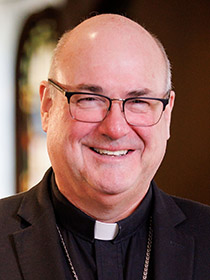
Archbishop Richard G.
Henning
Henning
Last spring, Pope Leo XIV offered the world the encyclical letter "Magnifica Humanitas." The letter confirmed the thought behind the Holy Father's choice of the papal name "Leo." His predecessor, Leo XIII, ministered in the midst of the Industrial Revolution. Beginning in the late 18th century and continuing throughout the 19th and into the 20th century, the Industrial Revolution brought remarkable new technologies, increasing wealth, and a host of disruptions to society, family life, and economies. Many people moved from traditional rural life to life in cities and towns and new kinds of work. With these changes and disruptions, poverty and suffering intensified even as wealth increased.
Pope Leo XIII saw the suffering and offered his encyclical letter "Rerum Novarum." Today, that letter is seen as a key moment in the development of the Catholic Church's social teaching. At the time, the Church drew upon its long history of thinking and teaching about the nature of human beings and the moral life and adapted that heritage for the challenges of a new age. While the adaptation was new, the foundations were ancient. It is also important to note that the Church's teaching had a profound impact on the efforts to address the excesses of the Industrial Revolution and to promote human welfare.
It has become clear that Pope Leo XIV recognizes the importance of his predecessor and sees parallels with our own time, as rapid technological advancement again offers promise and disruption. In his letter, Pope Leo sees humanity at a crossroads and seeks to offer the Church's prophetic voice for the challenges and opportunities of the moment. As he offers and applies Catholic social teaching to the rise of artificial intelligence and a new economy, he summons Catholics and all men and women of good faith to "remain profoundly human." (MH 15)
The letter frequently mentions and speaks about human dignity. The dignity of the person is conferred by divine providence and is most fully revealed in the Person of Jesus Christ. The Holy Father reminds us that such dignity is not conferred nor taken away by earthly power: "Human dignity does not depend on a person's abilities, wealth or position in life, nor on the right or wrong choices made; instead, it is a gift that precedes and transcends each person, endowed by God as an expression of his unfailing love." (MH 50)
While the letter addresses the rapid advancement of artificial intelligence, its concerns are wide-ranging. The Church has a long experience of the human capacity for good and our temptation to selfishness and sin. In every age, people are tempted to use technological advantage for self-gain, and the result is too often domination, oppression, suffering and injustice. At this crossroads, there is the promise of wealth for some and the risk of poverty for many more. The Holy Father reminds the world that the conversation about these matters begins not with the question of what technologies are possible, but rather what kind of society we wish to build. He brings key elements of Catholic moral thought to that question, such as the concern for the common good and the principle of subsidiarity.
As the Church and the world continue to receive the Holy Father's letter, here in Boston, we have begun a series of reflections on his contribution. Next week, I will resume this column with some observations from the first two gatherings and continue offering thoughts on "Magnifica Humanitas."
- Archbishop Richard G. Henning is the Archbishop of Boston
Help us expand our reach! Please share this article on social media

Recent articles in the Faith & Family section
-

Singing to the LordFather Robert M. O'Grady
-

SuperstitionArchbishop Richard G. Henning
-

Lessons Learned from the Missions -- Part IMaureen Crowley Heil
-

Settling accountsScott Hahn
-

Talents and crossesFather Joshua J. Whitfield


