

Faith
If the pro-life stance of the Church is founded on this God-given human dignity, I have been wondering lately if we might want to say that we are "pro-human."
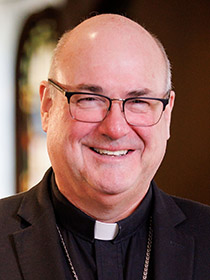
Archbishop Richard G.
Henning
In the 1970s, the grassroots pro-life movement arose when the U.S. Supreme Court swept away legal protections for children. At the time, the media made use of the term "pro-life" as presented by its participants. It was not long, however, before the media shifted its language, calling the pro-abortion advocates "pro-choice" and calling pro-life advocates "anti-choice." In addition to editorial support for abortion, the reporting itself also showed bias. The language describing pro-life advocates became increasingly harsh. This reached a fever pitch in 2022 when the Supreme Court returned the question of abortion to the state legislatures. At that point, vandalism, arson, and violent attacks were added to the denunciatory language against pro-life organizations and individuals.
One of the stranger allegations against pro-lifers is that opposition to abortion is extremist. I say "strange" because the pro-life stance rests on one of the most ordinary and fundamental elements of human life and society. There is no humanity without the birth, nurturing, and forming of children. You see this at work when parents discover they are expecting, rejoice with family and friends, and then welcome a new infant with hope and joy. There are few human experiences with more potential to bring people together and inspire them to offer protection and care.
This stance, that human persons have a sacred dignity conferred by God rather than defined by ideology or utility, rests upon the revealed authority of Sacred Scripture. Even more so, it is a response to the summons of the Lord Jesus Himself. The Lord gives us an example and a new commandment of the centrality of love. He shows us the power of compassion and the importance of imitating his own concern for the vulnerable and forgotten.
Pope Leo XIV reiterated this teaching of the Church in his recent encyclical "Magnifica Humanitas," as he considered the changes in our technology, culture and society. He said this about human dignity: "Human dignity does not depend on a person's abilities, wealth or position in life, nor on the right or wrong choices made; instead, it is a gift that precedes and transcends each person, endowed by God as an expression of his unfailing love." (50)
If the pro-life stance of the Church is founded on this God-given human dignity, I have been wondering lately if we might want to say that we are "pro-human." The threats to the sanctity of human life have multiplied over the last several decades. The most vulnerable one, the child in the womb, was the first to be discarded. During these same decades, senseless violence and cruelty have increased in shocking ways. Achingly painful acts of violence against children in school, the horrors of war magnified by ever more efficient weapons, and the rise of hatred and division assault the conscience and shatter families and communities. The same nations and states that removed laws protecting children in the womb now seek to legislate likewise against the sick and the elderly.
Even as we suffer these sins against God's law of love, we see with the eyes of faith the beauty that God intends for His people. It is not a moment to despair or to give up on humanity, but rather a moment to decide for that beauty and dignity revealed in the Lord Jesus, the Heart of God. For this reason and many others, I encourage all to read and hear Pope Leo's summons in "Magnifica Humanitas." His message might be occasioned by rapidly evolving new technologies, but it is a message that arises from the foundations of our faith and speaks to so many challenges to human life in our time. His message is pro-life and pro-human, and the world needs men and women who give such witness to "magnificent humanity."
- Archbishop Richard G. Henning is the Archbishop of Boston
Help us expand our reach! Please share this article on social media

Recent articles in the Faith & Family section
-

Singing to the LordFather Robert M. O'Grady
-

SuperstitionArchbishop Richard G. Henning
-

Lessons Learned from the Missions -- Part IMaureen Crowley Heil
-

Settling accountsScott Hahn
-

Talents and crossesFather Joshua J. Whitfield


