

Faith
Sept. 30 is the Feast of St. Jerome. It is a good day to remember his devotion to the Word of God and his immense effort to bring the light of God's Word to the people.
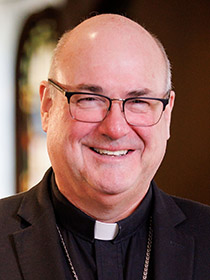
Archbishop Richard G.
Henning
A print of a famous Caravaggio painting of St. Jerome hangs on my office wall. St. Jerome was a foundational biblical scholar and is recognized as the patron saint of those who study and translate the sacred texts. The painting is a masterwork of fine art -- hardly surprising given the professional skill of the famous painter. Even so, I like it near at hand more for its message than the skill of its medium.
The painting depicts St. Jerome in old age as he labors at his life's work of studying and translating the Bible. He is seated at a desk with a disheveled appearance, wrapped in a blanket as if his first act upon waking was to return to his work. Facing him, there is a human skull, reminding him of the urgency of his work, as time is short. Overall, it is a picture of a man of full focus and devotion to the Word of God, and to his own work in helping the people of God to receive that Word in all its life-giving power.
I had the gift of studying the biblical languages and texts at The Catholic University of America and at the University of St. Thomas Aquinas in Rome. My own struggles to master ancient Greek and Hebrew helped me to appreciate the magnitude of St. Jerome's accomplishments. Born in Eastern Europe, he made his way to Rome and later to Syria in his quest to know and understand. Above all, he desired to know Greek and Hebrew well enough to bring the books of the Bible to the ordinary people of Europe. He spent his life creating the Vulgate, the Latin language translation of the Old and New Testaments. At the time, Latin was still the everyday language of the peoples in Western Europe.
His gifts continue to bless the Church even as we now translate into multiple contemporary languages. His own work was much closer to the original ancient versions of Greek and Hebrew, and his Vulgate still holds a place of honor in the annals and process of translation.
If you wonder why there are a bewildering number of Bible translations, the short answer is that translation is as much an art as a science. Sometimes, there are words that have obvious counterparts between languages. Often, however, a word or phrase may be difficult to render precisely. The process is further complicated by the role of culture. Languages use imagery, slang, and metaphor familiar to the speakers of that language. These same characteristics make the work of translating more complicated, especially when texts originate in the distant past. Even as a translator must study the vocabulary of a language, he or she must also work to understand that cultural and historical context.
I wonder how many Catholics are fully aware of the ongoing work of scholars and translators in this regard. For Catholics in the United States, the New American Version of the Bible is produced by work under the auspices of the U.S. Conference of Catholic Bishops. The process involves university scholars and American bishops who have studied the ancient languages and the Scriptures. I can promise you that the work involves enormous amounts of effort and fairly regular disputes. Founded on a deep reverence for the Holy Word of God, the disputes are driven by the same desire that motivated St. Jerome -- to bring the Scriptures alive in a new language and culture.
One last image from the Caravaggio portrait of St. Jerome is the source of the light. Caravaggio often played with light in his work. In this case, the painting makes it clear that the source of light before St. Jerome is the Bible open before him. He is intensely focused upon it, and its light suffuses his face.
Sept. 30 is the Feast of St. Jerome. It is a good day to remember his devotion to the Word of God and his immense effort to bring the light of God's Word to the people. I hope that his witness will draw us to bask in that same light -- to find challenge, wisdom, and consolation in the Sacred Page. I especially commend his example to those who proclaim the Word of God in the Sacred Liturgy. I hope that you take this ministry seriously, and I hope that you receive and proclaim that Word as a gift, and that you show humble reverence for the centuries of scholarly work and reflection upon the Word that has produced the translation before you.
- Archbishop Richard G. Henning is the Archbishop of Boston
Help us expand our reach! Please share this article on social media

Recent articles in the Faith & Family section
-

Singing to the LordFather Robert M. O'Grady
-

SuperstitionArchbishop Richard G. Henning
-

Lessons Learned from the Missions -- Part IMaureen Crowley Heil
-

Settling accountsScott Hahn
-

Talents and crossesFather Joshua J. Whitfield


